
Measure Competitive Intelligence by Its Impact—Not Its Activity
Competitive intelligence should not be measured by the number of reports produced, dashboards created, or updates delivered.
It should be measured by the decisions it improves and the business value it helps create.
That distinction has never been more important.
Competitive intelligence teams are under increasing pressure to demonstrate their value. Leadership wants to understand how intelligence helps the organization reduce risk, protect revenue, identify opportunities, accelerate decisions, allocate resources more effectively, and act with greater confidence.
ROCI®, or Return on Competitive Intelligence, provides a practical framework for connecting competitive intelligence activity to measurable business outcomes.
Developed by Proactive Worldwide, ROCI® helps organizations demonstrate how competitive intelligence contributes to outcomes such as:
- Revenue growth and protection
- Cost savings and cost avoidance
- Margin improvement
- Market share protection
- Faster and better decision-making
- Risk reduction
- Stronger strategic alignment
- Increased executive confidence
The goal isn’t simply to prove that intelligence teams are busy.The goal is to demonstrate that intelligence makes a difference.

What Is ROCI®?
Competitive intelligence should not be measured by the number of reports produced, dashboards created, or updates delivered.
It should be measured by the decisions it improves and the business value it helps create.
That distinction has never been more important.
Competitive intelligence teams are under increasing pressure to demonstrate their value. Leadership wants to understand how intelligence helps the organization reduce risk, protect revenue, identify opportunities, accelerate decisions, allocate resources more effectively, and act with greater confidence.
ROCI®, or Return on Competitive Intelligence, provides a practical framework for connecting competitive intelligence activity to measurable business outcomes.
Developed by Proactive Worldwide, ROCI® helps organizations demonstrate how competitive intelligence contributes to outcomes such as:
- Revenue growth and protection
- Cost savings and cost avoidance
- Margin improvement
- Market share protection
- Faster and better decision-making
- Risk reduction
- Stronger strategic alignment
- Increased executive confidence
The goal isn’t simply to prove that intelligence teams are busy.The goal is to demonstrate that intelligence makes a difference.
The History of ROCI®
Proactive Worldwide began developing and applying the ROCI® framework more than two decades ago to address one of the most persistent challenges in competitive intelligence: demonstrating its contribution to the business.
The framework built upon the pioneering work of Jan Herring, widely recognized as one of the foundational leaders of the competitive intelligence profession. In his work on measuring CI effectiveness, Herring identified several important ways intelligence could create measurable organizational value, including time savings, cost savings, cost avoidance, revenue increases, and value-added benefits.
Those concepts provided an important foundation for thinking beyond intelligence activity and toward intelligence impact.
Building on Herring’s work, David Kalinowski and Gary Maag of Proactive Worldwide developed ROCI® as a more comprehensive and practical framework for helping intelligence professionals identify, assess, document, and communicate the value their work creates.
ROCI® was originally launched in 2006 and subsequently published through Strategic and Competitive Intelligence Professionals—now the Strategic Consortium of Intelligence Professionals—in 2012 as “ROCI®: A Framework for Determining the Value of Competitive Intelligence.”
The framework was designed from the beginning to be flexible rather than formulaic. It recognizes that intelligence can have direct or indirect impact, short-term or long-term impact, and quantitative or qualitative value.
Since its original launch in 2006 and publication in 2012, Proactive Worldwide has continued to apply, test, and refine ROCI® through client engagements, intelligence programs, consulting assignments, workshops, and training. The underlying principle, however, has remained remarkably consistent:
Competitive intelligence earns organizational credibility when its contribution to better decisions and business outcomes can be demonstrated.

Why Proving Competitive Intelligence Value Matters
Many competitive intelligence, market research and insights teams do excellent work. The problem is that the impact of that work often remains invisible.
An insight may influence a pricing decision, reshape a product launch, strengthen a market-entry strategy, identify a threat earlier, improve a competitive response, prevent an unnecessary investment, or give leadership confidence to pursue an opportunity.
But if nobody captures that impact, 6 or 12 months later the organization may remember the decision, and forget the intelligence that helped make it possible.
That creates real risks:
- Leadership may view CI as overhead rather than a strategic capability.
- Intelligence budgets may become vulnerable during cost reductions.
- Teams may optimize for output volume rather than business impact.
- Stakeholders may not understand how intelligence improves decisions.
- Successful intelligence work may not receive appropriate recognition or investment.
The danger is particularly acute when budgets tighten.
A CI leader who says, “We produced 75 reports, push out a weekly newsletter, and sent 150 competitive alerts,” is demonstrating activity.
A CI leader who can say, “Our intelligence influenced these eight strategic decisions, helped protect this revenue, identified these risks, accelerated these decisions, and changed these executive actions,” is demonstrating value.
That is the conversation ROCI® is designed to enable.
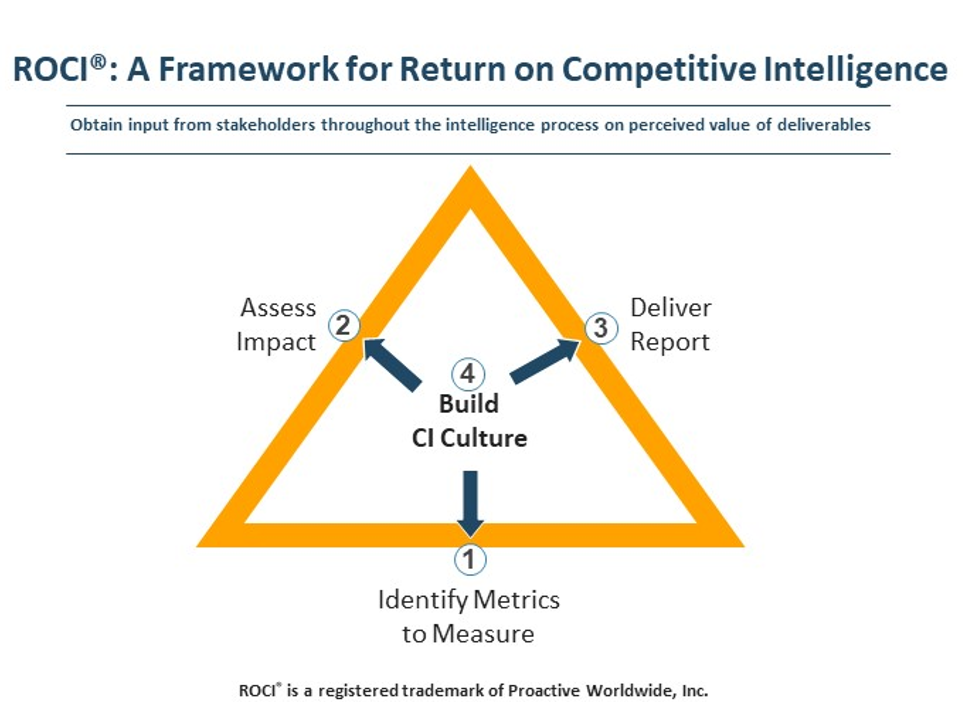
The Four Dimensions of ROCI®
1. Start With the Decision, Not the Deliverable
One of the most important principles behind ROCI® is that demonstrating value should not begin after the project is finished.
It begins before the work starts.
Before accepting an intelligence request, teams should understand:
- What decision needs to be made?
- Why does the decision matter?
- Who will use the intelligence?
- What is at stake?
- What would leadership do differently based on what is learned?
- How will the stakeholder determine whether the intelligence was valuable?
That last question is especially important.
The stakeholder, not the intelligence professional, is ultimately the judge of value.
A beautifully researched 80-page report has little value if it doesn’t influence anything. Conversely, one insight delivered at precisely the right moment could alter a multimillion-dollar decision.
Value is not determined by the amount of intelligence produced. It is determined by what the intelligence enables. This is why ROCI® should be considered at the beginning of an engagement rather than calculated retrospectively at the end.
2. What ROCI® Helps Organizations Measure
ROCI® recognizes that competitive intelligence creates value in different ways. Some are readily quantifiable; others are strategic, operational, or organizational.
Financial outcomes
- Revenue gained or retained
- Margin improvement
- Costs savings
- Cost avoidance
- Pricing optimization
- Market share protection
- Losses avoided
- Investment risk reduced
Strategic outcomes
- Evaluate new markets
- Clarify strategic options
- Anticipate competitive responses
- Prioritize investments
- Identify threats earlier
- Improve product strategies
- Strengthen scenario and contingency planning
- Make better M&A or partnership decisions
Operational outcomes
- Faster decision-making
- Reduced duplication of effort
- Better prioritization
- More effective resource allocation
- Shorter research and planning cycles
- Better coordination across teams
- Time savings for executives and employees
Organizational Impact
- Stronger executive sponsorship
- Increased stakeholder engagement
- Better cross-functional alignment
- Greater use of intelligence in decision-making
- Improved intelligence-sharing practices
- Greater confidence in evidence-based decisions
Not every outcome can be expressed in dollars.
However, every meaningful intelligence initiative should be connected to a defined business result.
3. Direct, Indirect, Short-Term and Long-Term Value
One of the strengths of ROCI® is that it recognizes that intelligence does not influence every decision in the same way.
Impact may be:
Direct — Intelligence has a clear connection to a subsequent decision or action.
Indirect — Intelligence is one of several inputs that shape management thinking or a decision.
Short-term — The benefit is realized relatively quickly, such as changing a price, competitive response, sales strategy, or launch plan.
Long-term — Intelligence contributes to strategic decisions whose impact may emerge over months or years.
Similarly, impact can be quantitative or qualitative.
Trying to claim that intelligence was solely responsible for a $50 million strategic outcome when many other factors contributed will quickly undermine credibility.
ROCI® isn’t about taking credit for everything.
It is about credibly demonstrating contribution. Perhaps 20% of that $50M outcomes is attributed to the work of the intel team. The stakeholder will let you know. That distinction matters.
4. Make the Impact Visible
The final step is communication. Build a Ci-supportive culture.
Organizations shouldn’t assume executives will automatically connect intelligence work performed months earlier with the outcomes that followed.
CI leaders need to make that connection visible.
That might include:
- Quarterly ROCI® or intelligence-impact dashboards
- Short decision-impact case studies
- Stakeholder testimonials
- Executive briefings
- Post-project evaluations
- Annual CI impact reports
The objective isn’t self-promotion.
It is organizational understanding.
Leadership should be able to see where intelligence was applied, what decisions it influenced, what business outcomes resulted, and what the organization received in return for its investment.
Be sure to have a C-Suite champion who shares your CI success stories and emphasizes with you the importance and value of the CI capability, so it becomes embedded into virtually every functional discipline.
Over time, this also creates something even more valuable: a body of evidence demonstrating the cumulative contribution of intelligence to the enterprise.eadership.
How to Build a ROCI® Mindset
ROCI® should not be an annual exercise conducted when someone asks the CI team to justify its budget.
It should become part of how the intelligence function operates.
Before an engagement, identify the decision, clarify the stakes, define success, establish potential measures of value, and understand who will use the intelligence.
During the engagement, maintain alignment with the decision, communicate emerging implications, test assumptions, and capture important shifts in stakeholder understanding.
After the engagement, don’t simply send the final deliverable and move on. Ask what happened. And many times that ask to the decision-maker has to happen 6, 12, or 18 months later after a decision has been made and the impact is visible.
How was the intelligence used? What decision was made? What changed? What action did leadership take? What risk was avoided? What opportunity was pursued? Did the intelligence accelerate the decision? What additional intelligence is now needed?
And on an ongoing basis, aggregate those individual examples into a broader picture of the intelligence function’s contribution.
This is where many organizations fall short.
They do valuable work.
They simply don’t capture the evidence.

Examples of ROCI® in Practice
ROCI® can be applied to individual projects, recurring intelligence programs, and enterprise-wide CI functions.
Pricing Intelligence
Competitive pricing intelligence may help an organization refine discounting practices, identify margin opportunities, or avoid pricing below market expectations.
Possible ROCI® measures include:
- Revenue retained
- Margin improved
- Pricing risk avoided
- Discount levels adjusted
- Sales confidence increased
Market Entry
Market and competitive intelligence may help leadership determine whether to enter a new geography, segment, or product category.
Possible ROCI® measures include:
- Investment risk reduced
- Market opportunity clarified
- Entry strategy improved
- Unattractive markets avoided
- Decision time shortened
Product Launch
Competitive intelligence may identify competitor positioning, customer needs, potential objections, and likely market responses before launch.
Possible ROCI® measures include:
- Launch strategy strengthened
- Messaging improved
- Competitive risks anticipated
- Sales preparation accelerated
- Revenue opportunities protected
Strategic War Gaming
A war game may help leaders anticipate competitor responses, challenge assumptions, and prepare contingency plans.
Possible ROCI® measures include:
- Strategic options clarified
- Risks identified earlier
- Leadership alignment improved
- Response time shortened
- Contingency plans strengthened
Ongoing Monitoring
A continuous monitoring program may alert leadership to emerging threats, competitor activity, market changes, or new opportunities.
Possible ROCI® measures include:
- Earlier risk detection
- Faster organizational response
- Business disruption avoided
- Opportunities identified sooner
- Executive awareness improved

ROCI® and PWWDiscovery™
ROCI® and PWWDiscovery™ serve complementary roles in Proactive Worldwide’s approach to strategic intelligence.
PWWDiscovery™ provides a structured program for uncovering, analyzing, monitoring, and applying competitive, market, customer, and pricing intelligence. ROCI® provides a structured framework to measure and communicate the value that intelligence creates.
Together, the frameworks help organizations move through the complete intelligence lifecycle:
- Define the decision.
- Gather and analyze the right intelligence.
- Translate findings into action.
- Measure the resulting business impact.
- Communicate that value to stakeholders.
Why ROCI® Matters More in the Age of AI
Organizations now have access to more information—and can generate analysis faster—than at any previous point in the history of competitive intelligence.
AI can summarize documents, synthesize large amounts of content, identify patterns, and generate reports in seconds.
That makes measuring intelligence by output even less meaningful.
Producing another report is becoming easier.
Determining which information is credible, what signals actually matter, what is missing, what competitors and customers may do next, and how those insights should affect a consequential business decision remains far more difficult.
And ultimately, that is where intelligence creates value.
The question for the intelligence profession therefore shouldn’t be:
How much intelligence did we produce?
It should increasingly be:
What decisions did we improve, and what changed because of our contribution?
ROCI® provides a framework for answering that question.